

ASN Wikibase Occurrence # 334738
| Date: | Tuesday 14 February 1956 |
| Time: | 15:38 |
| Type: | 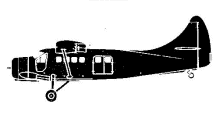 de Havilland Canada U-1A Otter (DHC-3) |
| Owner/operator: | United States Army |
| Registration: | 55-3252 |
| MSN: | 92 |
| Year of manufacture: | 1956 |
| Fatalities: | Fatalities: 4 / Occupants: 4 |
| Aircraft damage: | Destroyed, written off |
| Category: | Accident |
| Location: | Toronto, ON -
 Canada Canada
|
| Phase: | En route |
| Nature: | Military |
| Departure airport: | Toronto-Downsview Airport, ON (YZD/CYZD) |
| Toronto-Downsview Airport, ON (YZD/CYZD) |
A group of three U-1A Otters were allocated for training flights out of the Downsview Airport, in the course of pre-delivery U.S. Army pilot training. Otter 55-3252 departed the airport at 15:21. Seventeen minutes later the aircraft broke up in midair. It crashed near Keele Street, killing all aboard.
Initial investigations concluded that the airplane broke up after entering wake turbulence. Investigation into the accident of RCAF Otter 3666 which crashed April 10 of the same year revealed that the this accident may have been preceded by a sudden spontaneous full flap retraction.
Sources:
Air crash : the clue is in the wreckage / Fred Jones
Revision history:
| Date/time | Contributor | Updates |
|---|
The Aviation Safety Network is an exclusive service provided by:
Quick Links:
| ASN Home | Send Correction / Feedback |
| FSF Home | Disclaimer | Copyright |
| Contact Us | Privacy Policy |
| Press / Media |
 CONNECT WITH US:
 ©2024 Flight Safety Foundation