

ASN Wikibase Occurrence # 324834
| Date: | Tuesday 13 December 1994 |
| Time: | 18:34 |
| Type: | 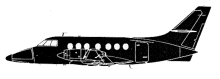 British Aerospace 3201 Jetstream 32 |
| Owner/operator: | American Eagle |
| Registration: | N918AE |
| MSN: | 918 |
| Year of manufacture: | 1990 |
| Total airframe hrs: | 6577 hours |
| Engine model: | Garrett TPE331-12 |
| Fatalities: | Fatalities: 15 / Occupants: 20 |
| Aircraft damage: | Destroyed, written off |
| Category: | Accident |
| Location: | 7,4 km SW of Raleigh/Durham Airport, NC (RDU) -
 United States of America United States of America
|
| Phase: | Approach |
| Nature: | Passenger - Scheduled |
| Departure airport: | Greensboro/High Point-Piedmont Triad International Airport, NC (GSO/KGSO) |
| Raleigh/Durham Airport, NC (RDU/KRDU) | |
| Investigating agency: | NTSB |
| Confidence Rating: |  Accident investigation report completed and information captured Accident investigation report completed and information captured |
Flight 3379 departed Greensboro at 18:03 with a little delay due to baggage rearrangement. The aircraft climbed to a 9000 feet cruising altitude and contacted Raleigh approach control at 18:14, receiving an instruction to reduce the speed to 180 knots and descend to 6000 feet. Raleigh final radar control was contacted at 18:25 and instructions were received to reduce the speed to 170 knots and to descend to 3000t. At 18:30 the flight was advised to turn left and join the localizer course at or above 2100 feet for a runway 05L ILS approach. Shortly after receiving clearance to land, the no. 1 engine ignition light illuminated in the cockpit as a result of a momentary negative torque condition when the propeller speed levers were advanced to 100% and the power levers were at flight idle. The captain suspected an engine flame out and eventually decided to execute a missed approach. The speed had decreased to 122 knots and two momentary stall warnings sounded as the pilot called for max power. The aircraft was in a left turn at 1800 feet and the speed continued to decrease to 103 knots, followed by stall warnings. The rate of descent then increased rapidly to more than 10000 feet/min. The aircraft eventually struck some trees and crashed about 4nm SW of the runway 5L threshold.
PROBABLE CAUSE: "1) The captain's improper assumption that an engine had failed and 2) the captain's subsequent failure to follow approved procedures for engine failure single-engine approach and go-around, and stall recovery.
Contributing to the cause of the accident was the failure of AMR Eagle/Flagship management to identify, document, monitor and remedy deficiencies in pilot performance and training."
Accident investigation:
 |
|

Sources:
ICAO Adrep Summary 1/95
ICAO Adrep Summary 5/96
NTSB/AAR-95/07
Commuter Captain Fails to Follow Emergency Procedures After Suspected Engine Failure, Loses Control of the Aircraft During Instrument Approach (Flight Safety Foundation - Accident Prevention April 1996)
Location
Images:

photo (c) NTSB; near Morrisville, NC; December 1994; (publicdomain)

photo (c) NTSB; near Morrisville, NC; December 1994; (publicdomain)
Revision history:
| Date/time | Contributor | Updates |
|---|
The Aviation Safety Network is an exclusive service provided by:
Quick Links:
| ASN Home | Send Correction / Feedback |
| FSF Home | Disclaimer | Copyright |
| Contact Us | Privacy Policy |
| Press / Media |
 CONNECT WITH US:
 ©2024 Flight Safety Foundation