

ASN Wikibase Occurrence # 323296
| Date: | Sunday 29 April 2001 |
| Time: | 13:12 |
| Type: | 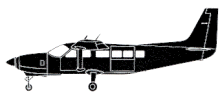 Cessna 208 Caravan I |
| Owner/operator: | A. McVinish |
| Registration: | VH-MMV |
| MSN: | 20800003 |
| Year of manufacture: | 1985 |
| Total airframe hrs: | 8576 hours |
| Engine model: | Pratt & Whitney Canada PT6A-114 |
| Fatalities: | Fatalities: 1 / Occupants: 12 |
| Aircraft damage: | Destroyed, written off |
| Category: | Accident |
| Location: | 4 km NW of Nagambie, VIC -
 Australia Australia
|
| Phase: | Manoeuvring (airshow, firefighting, ag.ops.) |
| Nature: | Parachuting |
| Departure airport: | Ballieston East, VIC |
| Ballieston East, VIC | |
| Investigating agency: | ATSB |
| Confidence Rating: |  Accident investigation report completed and information captured Accident investigation report completed and information captured |
The Cessna Caravan was carrying 11 skydivers and climbed to FL140. As the first team of four exited the aircraft, the middle parachutists reserve parachutes pilot chute deployed. Due to the bent over position of that parachutist, the action of the ejector spring in the pilot chute pushed the chute upwards and over the horizontal stabiliser of the aircraft, pulling the reserve canopy with it. The parachutist passed below the horizontal stabiliser resulting in the reserve parachute risers and lines tangling around the left elevator and horizontal stabiliser. Eleven seconds later, the empennage separated from the aircraft and the left elevator and the parachutist separated from the empennage. The aircraft then entered a steep, nose-down spiral descent. The pilot instructed the remaining parachutists to abandon the aircraft; the last one left the aircraft at an altitude of 9,000 feet. The pilot transmitted a mayday call, shutdown the engine and left his seat. On reaching the rear of the cabin, he found that the roller blind had closed, preventing him from leaving the aircraft. After several attempts, the pilot raised the blind sufficiently to allow him to exit the aircraft, and at an altitude of approximately 1,000 feet agl, he deployed his parachute and landed safely.
SIGNIFICANT FACTORS:
"1. The parachutists reserve parachute deployed prematurely, probably as a result of the parachute container coming into contact with the aircraft doorframe/handrail.
2. The reserve parachute risers and lines tangled around the horizontal stabiliser and elevator.
3. The reserve canopy partially filled, applying to the aircraft empennage a load that exceeded its design limits.
4. The empennage separated from the aircraft and the elevator separated from the empennage, releasing the parachutist and sending the aircraft out of control."
Accident investigation:
 |
|

Sources:
News.com.au
Richard Barrett
History of this aircraft
Other occurrences involving this aircraft
| 8 January 1995 | VH-MMV | A. McVinish | 0 | Toogoolawah Airport, QLD | |
sub |
Location
Revision history:
| Date/time | Contributor | Updates |
|---|
The Aviation Safety Network is an exclusive service provided by:
Quick Links:
| ASN Home | Send Correction / Feedback |
| FSF Home | Disclaimer | Copyright |
| Contact Us | Privacy Policy |
| Press / Media |
 CONNECT WITH US:
 ©2024 Flight Safety Foundation