

ASN Wikibase Occurrence # 322815
| Date: | Thursday 22 May 2003 |
| Time: | 11:00 |
| Type: | 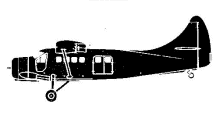 de Havilland Canada DHC-3 Otter |
| Owner/operator: | Whiteshell Air Service |
| Registration: | C-GGON |
| MSN: | 225 |
| Year of manufacture: | 1957 |
| Fatalities: | Fatalities: 0 / Occupants: 4 |
| Aircraft damage: | Substantial, repaired |
| Category: | Accident |
| Location: | 4 km E of Lac du Bonnet, MB -
 Canada Canada
|
| Phase: | Initial climb |
| Nature: | Passenger - Non-Scheduled/charter/Air Taxi |
| Departure airport: | Lac du Bonnet (North) SPB, MB |
| George Lake, MB | |
| Investigating agency: | TSB |
| Confidence Rating: |  Accident investigation report completed and information captured Accident investigation report completed and information captured |
A de Havilland Canada DHC-3 Otter, registered C-GGON, sustained substantial damage in an accident 4 km east of Lac du Bonnet, MB, Canada. All three passengers and the pilot survived. The airplane operated on a flight from Lac du Bonnet, MB to George Lake, MB.
The pilot completed a normal takeoff from the Winnipeg River in an easterly direction and began a shallow climb over the shoreline. As the aircraft levelled at approximately 400 feet agl, there was a loud backfire followed by a complete loss of engine power. The pilot force landed straight ahead; the aircraft struck several large trees and came to rest in a swampy area. The aircraft struck the ground on its left side, both wings broke off, and the engine was buried in the swampy ground.
FINDINGS AS TO CAUSES AND CONTRIBUTING FACTORS:
1. A spacer in the No. 3 cylinder push rod tube was installed incorrectly. This initiated the increased wear that eventually prevented the No. 3 exhaust valve from opening, resulting in hot exhaust gases migrating into the induction system and causing the engine failure.
2. Following replacement of the No. 1 cylinder, the operator did not complete a field barometric power reference check, which is used in early identification of an engine problem.
3. The valve adjustment screw protrusion was set beyond specified limits. Had the out-of-limits screw protrusion been noted during adjustment or during a scheduled inspection, an examination might have revealed the excessive wear in the valve train and prevented the engine failure.
Accident investigation:
 |
|

Sources:
TSB
History of this aircraft
Other occurrences involving this aircraft
| 23 June 2002 | C-GGON | Whiteshell Air Service | 0 | George Lake, MB | |
sub |
Revision history:
| Date/time | Contributor | Updates |
|---|
The Aviation Safety Network is an exclusive service provided by:
Quick Links:
| ASN Home | Send Correction / Feedback |
| FSF Home | Disclaimer | Copyright |
| Contact Us | Privacy Policy |
| Press / Media |
 CONNECT WITH US:
 ©2024 Flight Safety Foundation