

| Date: | Friday 22 July 2005 |
| Time: | 08:30 |
| Type: | 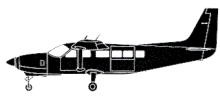 Cessna 208B Grand Caravan |
| Owner/operator: | CorpJet |
| Registration: | N717BT |
| MSN: | 208B0863 |
| Year of manufacture: | 2000 |
| Total airframe hrs: | 4461 hours |
| Engine model: | Pratt & Whitney Canada PT6A-114A |
| Fatalities: | Fatalities: 0 / Occupants: 1 |
| Aircraft damage: | Destroyed, written off |
| Category: | Accident |
| Location: | near Globe-San Carlos Apache Airport, AZ -
 United States of America United States of America
|
| Phase: | Initial climb |
| Nature: | Cargo |
| Departure airport: | Globe-San Carlos Apache Airport, AZ |
| Safford Airport, AZ (SAD/KSAD) | |
| Investigating agency: | NTSB |
| Confidence Rating: |  Accident investigation report completed and information captured Accident investigation report completed and information captured |
The Cessna Caravan was operated on a contract cargo flight for United Parcel Service (UPS). On the morning of the accident, the pilot flew the airplane from Phoenix to Globe with about 600 pounds of cargo and 1,600 pounds of fuel. The flight lasted approximately 30 minutes and he experienced no problems and noted no anomalies. At Globe, the pilot offloaded about 200 pounds of cargo and departed for Safford. He did not add fuel at Globe. He took off with a normal
takeoff flap setting of 20 degrees, and a takeoff power setting just below normal (which according to the pilot was between 1,800 and 1,900 RPM). During engine start he noted a normal inlet turbine temperature (ITT) and oil pressure indication, but during takeoff, he concentrated on torque setting and didn't notice the ITT and oil pressure during climb out.
The pilot heard a loud "thunk" and noted a loss of engine power. Three annunciator lights were illuminated ("low oil pressure, low fuel pressure, and low vacuum pressure"). He manipulated the power lever from the full forward position to the full aft position ("stop-to-stop") and noted he had no power. The pilot made a turn back toward the runway. During the turn, the descent rate was such that he realized he would not be able to make it back to the airport and concentrated on finding a landing area. The pilot initially set up to land on Highway 70, but believed there was too much traffic and he would hit something.
He then focused on landing in a field adjacent to the highway. The airplane touched down on the edge of Highway 70, bounced down an incline on the side of the road and came to rest upright in the dirt among scrub brush.
PROBABLE CAUSE: "The fatigue failure of the compressor turbine stator vane, the liberation of vane material into the compressor turbine, and the total loss of engine power. Also causal was the operator's failure to inspect the compressor turbine vane during fuel nozzle checks."
Accident investigation:
 |
|

Sources:
NTSB
History of this aircraft
Other occurrences involving this aircraft
| 13 November 2003 | N717BT | Baltimore Air Transport, Inc./corpjet | 0 | Phoenix, Arizona | |
sub |
Location
Revision history:
| Date/time | Contributor | Updates |
|---|
The Aviation Safety Network is an exclusive service provided by:
Quick Links:
| ASN Home | Send Correction / Feedback |
| FSF Home | Disclaimer | Copyright |
| Contact Us | Privacy Policy |
| Press / Media |
 CONNECT WITH US:
 ©2024 Flight Safety Foundation