

ASN Wikibase Occurrence # 44220
This information is added by users of ASN. Neither ASN nor the Flight Safety Foundation are responsible for the completeness or correctness of this information.
If you feel this information is incomplete or incorrect, you can submit corrected information.
| Date: | Tuesday 17 January 2006 |
| Time: | 20:30 |
| Type: | 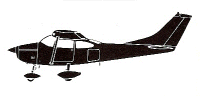 Cessna 182P Skylane |
| Owner/operator: | Private |
| Registration: | N6034J |
| MSN: | 18263611 |
| Year of manufacture: | 1975 |
| Engine model: | Continental O-470-RCS |
| Fatalities: | Fatalities: 1 / Occupants: 1 |
| Aircraft damage: | Destroyed |
| Category: | Accident |
| Location: | Big Pine, CA -
 United States of America United States of America
|
| Phase: | En route |
| Nature: | Private |
| Departure airport: | Bishop, CA (BIH) |
| Lone Pine, CA (O26) | |
| Investigating agency: | NTSB |
| Confidence Rating: |  Accident investigation report completed and information captured Accident investigation report completed and information captured |
The airplane impacted a hill about 34 miles north of the destination airport. The accident occurred under dark, nighttime, visual meteorological conditions. The airplane was en route on a 57-mile cross-country flight through a valley. The pilot frequently used the airplane to commute between the departure and destination points, accruing thousands of hours in the valley. The airplane wreckage was on a hill with about a 25-degree slope and located about 275 feet below the ridgeline's top. A heavily traveled highway was situated adjacent to the hill in the same north-south orientation as the route of flight. The wreckage distribution path was 400 feet long on a magnetic bearing of about 340 degrees. An examination of the impact ground scars disclosed that the airplane was in controlled flight in a near level configuration when it collided with the terrain. At the time of the accident, the moon was 3.7 degrees above the eastern horizon but blocked by mountains to the east. It is likely the lights from the automobiles on the highway would have been visible to the pilot, but there were no lights to distinguish the rising terrain. During the wreckage examination of the airframe's structure and the engine, no evidence of any preimpact failures or malfunctions was found.
Probable Cause: the pilot's failure to maintain an adequate terrain clearance altitude during a cruise descent that resulted in controlled flight into terrain (CFIT). Factors in the accident were the rising mountainous terrain, the dark nighttime lighting condition.
Accident investigation:
 |
|

Sources:
NTSB: https://www.ntsb.gov/_layouts/ntsb.aviation/brief.aspx?ev_id=20060125X00119&key=1
Location
Revision history:
| Date/time | Contributor | Updates |
|---|---|---|
| 28-Oct-2008 00:45 | ASN archive | Added |
| 21-Dec-2016 19:24 | ASN Update Bot | Updated [Time, Damage, Category, Investigating agency] |
| 05-Dec-2017 09:00 | ASN Update Bot | Updated [Operator, Other fatalities, Source, Narrative] |
Corrections or additions? ... Edit this accident description
The Aviation Safety Network is an exclusive service provided by:
Quick Links:
| ASN Home | Send Correction / Feedback |
| FSF Home | Disclaimer | Copyright |
| Contact Us | Privacy Policy |
| Press / Media |
 CONNECT WITH US:
 ©2024 Flight Safety Foundation